The Always-On Trap: How After-Hours Email Expectations Are Quietly Burning Out Your Team
Research reveals after-hours email expectations cause burnout through anticipatory stress, not time spent. Here's what the science says.
Inbox Ninja Team
Inbox Ninja
It starts innocently enough. You're watching TV with your family when your phone buzzes. A work email. Nothing urgent—just a colleague asking for input on a document. You could ignore it until morning, but you don't. You fire off a quick reply. Problem solved, right?
Not quite.
That 9 PM response just sent a signal. To your colleague, it confirmed that you're available. To your subconscious, it reinforced that work never really ends. And to your team, it nudged the cultural expectation one degree closer to "always on."
The research on after-hours email is unequivocal: the expectation of constant availability is making us exhausted, anxious, and less productive. And the kicker? It's not the time spent answering emails that burns people out—it's the anticipatory stress of knowing they might have to.
If you only have 60 seconds: after-hours email is less dangerous because of reply time than because of anticipation. If your team keeps hearing the notification ding at night, it never fully leaves work mode. The fastest fixes are shared response-time norms, scheduled send, and a separate channel for truly urgent issues.
The Scope of the Problem
We're drowning in email, and the tide keeps rising. The average knowledge worker spends six hours per week managing email during work hours. Ten percent clock over 20 hours weekly—essentially half their workweek in the inbox alone.
But the real damage happens after hours.
According to a July 2025 ZeroBounce survey of 1,000 American workers, 47% of professionals intentionally avoid emails sent after hours to protect their mental health. Nearly half find after-hours communication actively disruptive. And yet, the expectation persists.
More than half of Americans report checking work-related messages at least once over the weekend. Seven percent spend five or more hours weekly checking email off the clock. Nearly 40% admit to compulsively checking their inbox even when they know it stresses them out—a phenomenon researchers call "inbox doomscrolling."
If that feels familiar, it's because after-hours email is not a side problem. It's part of the same pattern behind The Infinite Workday Starts in Your Inbox: work begins in email before breakfast and comes back again at night.
The psychological toll is measurable. A quarter of workers say just 10 unread emails are enough to trigger anxiety or overwhelm. The average person starts feeling stressed after 65 unread messages pile up. And 61% have forgotten to reply to an email entirely because of stress or anxiety.
This isn't just an individual problem—it's an organizational one.
The Science of Anticipatory Stress
Here's what makes after-hours email so insidious: you don't actually have to read or respond to experience its negative effects.
A landmark study by researchers at Lehigh University, Virginia Tech, and Colorado State University—presented at the Academy of Management—found that organizational expectations regarding after-hours email are a significant job stressor, independent of the actual time spent on email.
The researchers surveyed 297 working adults across finance, technology, healthcare, and other industries. Their findings were striking: the mere expectation that employees should monitor and respond to email after hours creates what psychologists call "anticipatory stress."
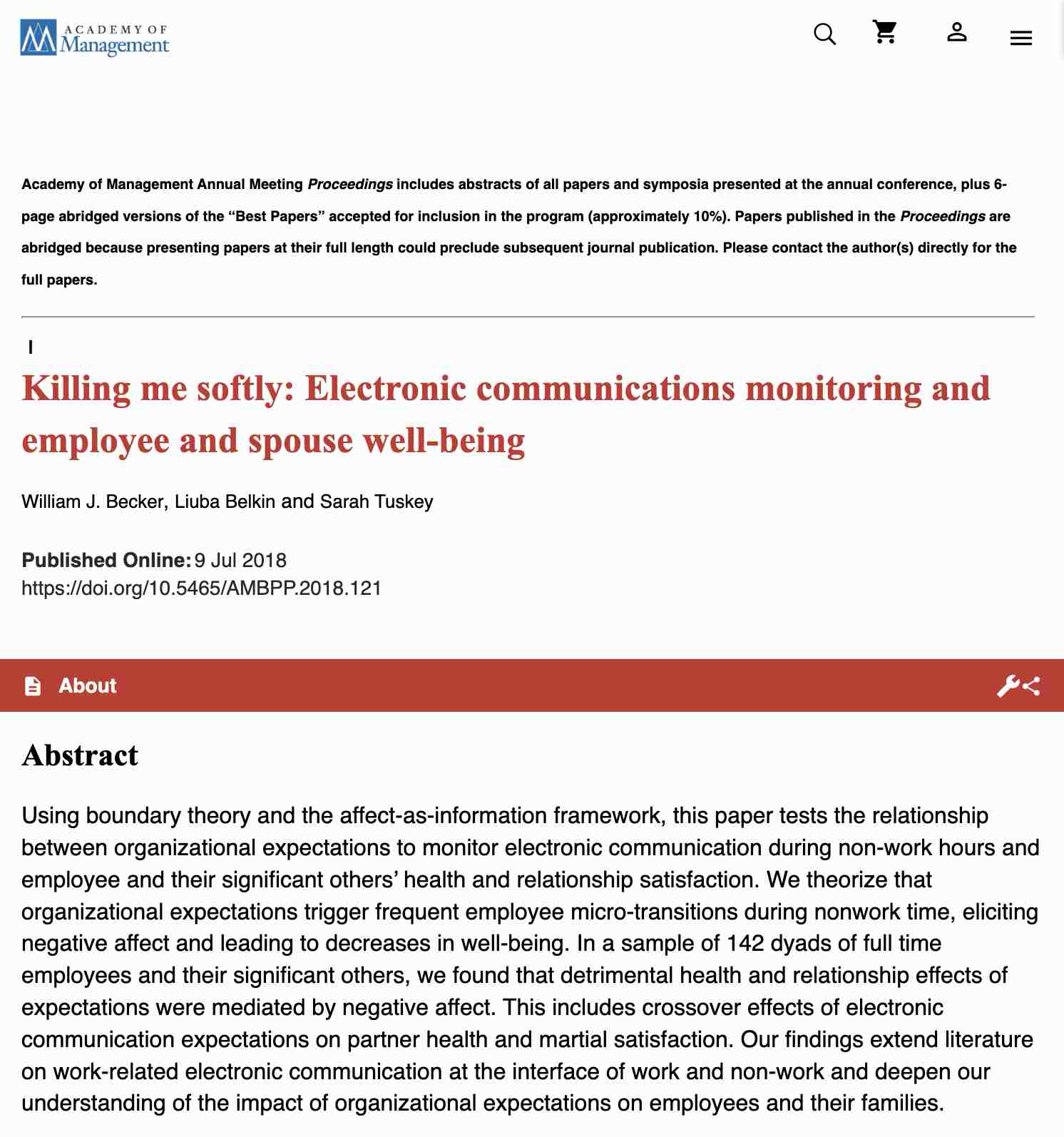
Source: Becker, Belkin, Conroy & Tuskey — "Exhausted, but Unable to Disconnect", Academy of Management Proceedings.
"It's not only that employees are spending a certain amount of extra time answering emails, but it's that they feel they have to be ready to respond and they don't know what the request will be," explains Samantha Conroy, assistant professor of Management at Colorado State University. "So if they're having dinner with their family, and hear that 'ding,' they feel they have to turn their attention away from their family and answer the email."
This anticipatory stress—the constant low-grade anxiety that a work demand could arrive at any moment—prevents the psychological detachment necessary for recovery. Even when no email arrives, the cognitive resources spent waiting for it are gone. Your brain never fully leaves work mode.
The study's title says it all: "Exhausted, but Unable to Disconnect."
The Real Costs: Burnout, Hostility, and Reduced Performance
The consequences of this constant connectivity extend far beyond temporary stress. Research published in September 2024 found that responding to work emails after hours contributes directly to burnout, emotional exhaustion, and counterproductive workplace behavior.
The study, conducted through a survey of 315 full-time U.S. employees, draws upon "conservation of resources theory"—the idea that employees have limited mental and emotional reserves that must be replenished. After-hours communication depletes those reserves without giving them time to restore.
The data was unequivocal: engaging in work-related communication after regular business hours leads to emotional exhaustion, which in turn spills over into hostility toward employers and other negative behaviors.
"When the boundaries between home and work are eroded, it doesn't just hurt people's job and life satisfaction—it affects organizational performance, too," the researchers noted.
Previous research has shown that recovery from work demands requires both physical and psychological detachment. You need to not just leave the office, but mentally disengage from work concerns. Email accessibility destroys this recovery process. It allows employees to engage with work "as if they never left the workspace," while simultaneously preventing the psychological detachment essential for well-being.
The irony is brutal: the technology designed to increase flexibility and productivity is actively undermining both.
The Right to Disconnect Movement
Recognizing these harms, governments and organizations worldwide are implementing "right to disconnect" policies—formal protections allowing employees to disengage from work communications outside working hours without fear of negative consequences.
Source: Fair Work Ombudsman — Right to disconnect, Australian government, captured May 2026.
France pioneered the approach in 2017, requiring companies with more than 50 employees to negotiate agreements establishing periods when employees are not expected to send or respond to work communications. Since then, the movement has spread:
- Spain incorporated right-to-disconnect provisions in 2018 data protection legislation
- Portugal explicitly prohibited employers from contacting employees outside working hours except in emergencies (2021)
- Belgium introduced comprehensive legislation covering federal and private sector employees (2022)
- Ireland established an enforceable code of practice (2021)
- Australia granted employees the right to refuse to monitor, read, or respond to employer contact outside working hours unless such refusal is "unreasonable" (2024)
The early results are promising. Australian survey data reveals that 58% of employers reported positive effects on employee engagement and productivity following right-to-disconnect implementation. Only 4% reported negative effects.
A comprehensive 2026 dissertation analyzing multiple jurisdictions found that well-implemented right-to-disconnect policies demonstrate meaningful reductions in burnout—up to 25% in some studies—along with productivity improvements of approximately 12%.
But the research also reveals a critical caveat: the mere existence of formal policies proves insufficient.
Source: Hacker News — search "right to disconnect", captured May 2026.
Why Policies Alone Don't Work
A 2023 study on workplace "telepressure"—the preoccupation with and urge to respond immediately to work communications—found that having a formal disconnection policy in place did not, by itself, reduce telepressure or associated strain.
What mattered more? Implicit norms and cultural expectations regarding responsiveness. If the unwritten rule is that "good employees" answer quickly, the formal policy becomes background noise.
This finding echoes across the research. A 2026 analysis of right-to-disconnect effectiveness identified three necessary conditions for policies to actually work:
-
Managerial behavior — Supervisors serve as role models. When managers send after-hours emails, they implicitly signal availability expectations, regardless of formal policy. Managers who respect boundaries and actively discourage after-hours contact create environments conducive to genuine disconnection.
-
Cultural alignment — Policies must match the prevailing organizational culture. Disconnection policies imposed on "always-on" cultures without addressing root expectations often fail. The stereotype of the "ideal worker"—always available, prioritizing work over personal life—must be actively dismantled.
-
Genuine enforcement — Policies that are easily circumventable or ignored without consequence quickly become symbolic. Organizations need accountability mechanisms that make disconnection real.
As one research team noted: "Cultural expectations and digital addictiveness have combined to establish acceptable norms of extended availability after hours, on weekends, and on vacation. When workers perceive that their organization values work-life integration—such as bringing work home—they are less able to detach from work even when they would prefer to."
What Actually Works: Evidence-Based Interventions
If policies alone aren't enough, what does work? The University of Manchester conducted a quasi-experimental intervention study that offers a roadmap.
The research team implemented team-level email guidelines designed to reduce ICT (information and communication technology) demands. Rather than company-wide mandates, they worked with individual teams to establish shared norms around email use.
The results were significant:
- Reduced techno-overload — Participants reported feeling less overwhelmed by communication technology
- Reduced techno-invasion — Work felt less intrusive on personal time
- Decreased email monitoring frequency — People checked email less compulsively
- Less time on email during non-work hours — The boundary between work and personal time strengthened
Most importantly, these reductions functioned as the mediating mechanism for improvements in work-home conflict, psychological detachment, burnout, and performance. When email demands decreased, well-being increased.
The intervention was replicated in a private sector international context with similar positive effects on constant connectivity demands and burnout—suggesting the approach generalizes across industries.
Practical Solutions for Teams
Based on the research, here are evidence-based strategies for teams looking to break the always-on trap:
1. Establish Team Communication Charters
Don't wait for company-wide policy. Work with your immediate team to establish shared norms. Questions to address:
- What constitutes "urgent" enough for after-hours contact?
- Are there core hours when everyone should be available?
- What's the expected response time for non-urgent emails?
- How should time-sensitive requests be flagged?
Document these agreements and revisit them regularly. The act of collectively establishing norms reduces the ambiguity that drives anticipatory stress.
2. Model Boundary-Respecting Behavior
If you're in a leadership position, your behavior sets the standard. Practical steps:
- Use scheduled send for emails drafted after hours
- Avoid sending non-urgent communications on weekends
- Explicitly tell your team you don't expect immediate responses
- Share when you're disconnecting (e.g., "I'll be offline tomorrow afternoon—see you Thursday")
If you're not in leadership, you can still model boundaries by being consistent about your own availability and respecting others' stated limits.
3. Separate Urgent from Important
Much after-hours email is neither urgent nor important—it's just convenient for the sender. Establish team agreements about what communication channels to use for different urgency levels:
- Immediate response needed — Phone call or synchronous chat with clear "urgent" flag
- Response needed today — Direct message or email with "today" in subject
- Response needed this week — Standard email
- No urgency — Email, shared document comment, or async collaboration tool
When everyone knows the signals, the default assumption shifts from "always urgent" to "probably can wait."
4. Protect Recovery Time
Research consistently shows that recovery requires both physical and psychological detachment. Practical protections:
- Remove work email from personal phones (42% of Americans have done this or considered it)
- Establish "email-free" periods—evenings, weekends, vacations
- Use out-of-office messages not just for vacation, but for focused work periods
- Actually use your vacation time (and truly disconnect during it)
The research is clear: recovery isn't a luxury—it's a performance requirement. Fatigued, stressed employees demonstrate diminished cognitive function, reduced creativity, and elevated error rates.
5. Address the Root Cause: Workload
Sometimes after-hours email is a symptom of unmanageable workload. If your team consistently needs evenings and weekends to keep up, the solution isn't better email management—it's addressing capacity.
Research from Mental Health UK's 2026 Burnout Report found that unmanageable workload was the top stressor for 42% of workers. Email overload often masks deeper resource constraints that need executive attention.
Related reading
If after-hours email is draining your team, three related Inbox Ninja guides go deeper on the adjacent problems:
- The Infinite Workday Starts in Your Inbox explains how email becomes the hidden system that stretches work from early morning into late evening.
- How to Overcome Email Anxiety breaks down the psychological loop that turns a growing inbox into a daily stress trigger.
- Best AI Email Assistant in 2026 helps if you are actively evaluating tools that can reduce after-hours triage load instead of simply moving the same pressure onto a faster-looking inbox.
After-Hours Email FAQ
Is after-hours email burnout caused by the time spent replying or by the expectation itself?
The research points to both, but the expectation itself is the more overlooked driver. Even before someone replies, the possibility of a new request creates anticipatory stress that keeps them mentally tethered to work.
Do right-to-disconnect policies work?
They can, but only when manager behavior and team norms match the written policy. A formal rule without cultural enforcement usually turns into symbolic compliance rather than real recovery time.
What should a team do first if after-hours email is becoming normal?
Start with a team communication charter: define what counts as urgent, what channel urgent issues should use, and the expected response time for standard email. That removes the ambiguity that fuels compulsive checking.
The Path Forward
The always-on culture didn't emerge overnight, and it won't be dismantled overnight either. But the research direction is clear: organizations that protect employee recovery time see measurable benefits in engagement, productivity, and retention.
The right to disconnect isn't about reducing productivity or diminishing service. It's about recognizing that sustainable high performance requires sustainable working conditions. As one legal firm that implemented disconnection policies explained: "Rest is productive. Boundaries build trust. Sustainable performance is more valuable than constant presence."
For individuals, the research offers both validation and a path forward. Your stress about after-hours email isn't a personal failing—it's a rational response to genuinely harmful working conditions. And while you may not be able to change organizational culture overnight, you can start with your own team: establish shared norms, model boundary-respecting behavior, and protect your recovery time.
The inbox will always be there. The question is whether you're willing to close it—and whether your organization will let you.
Inbox Ninja helps teams manage email overload with assisted drafting, priority triage, and automated follow-ups—so you can focus on work that matters during work hours, and actually disconnect when the day ends.
Related Articles
The Infinite Workday Starts in Your Inbox
Microsoft's 2025 data shows workers face 275 interruptions a day. Here's why your inbox is likely the front door to fragmented work—and how to fix it.
The Best AI Email Writers in 2026, Ranked by What They Actually Draft
Looking for the best AI email writer in 2026? This guide ranks eight tools by the thing buyers actually care about: the draft that shows up on screen, how much you still rewrite, and whether the tool helps clear the surrounding inbox work.
AI Email Assistant for Gmail: What Works in 2026, What Doesn't, and How to Choose One
Gmail has its own AI features. So does every email assistant on the market. Here's what each actually does for your inbox, and how to pick one without wasting a week.
Ready to hit inbox zero?
Inbox Ninja triages your email, summarizes threads, and drafts replies in your voice.
Open Inbox Ninja